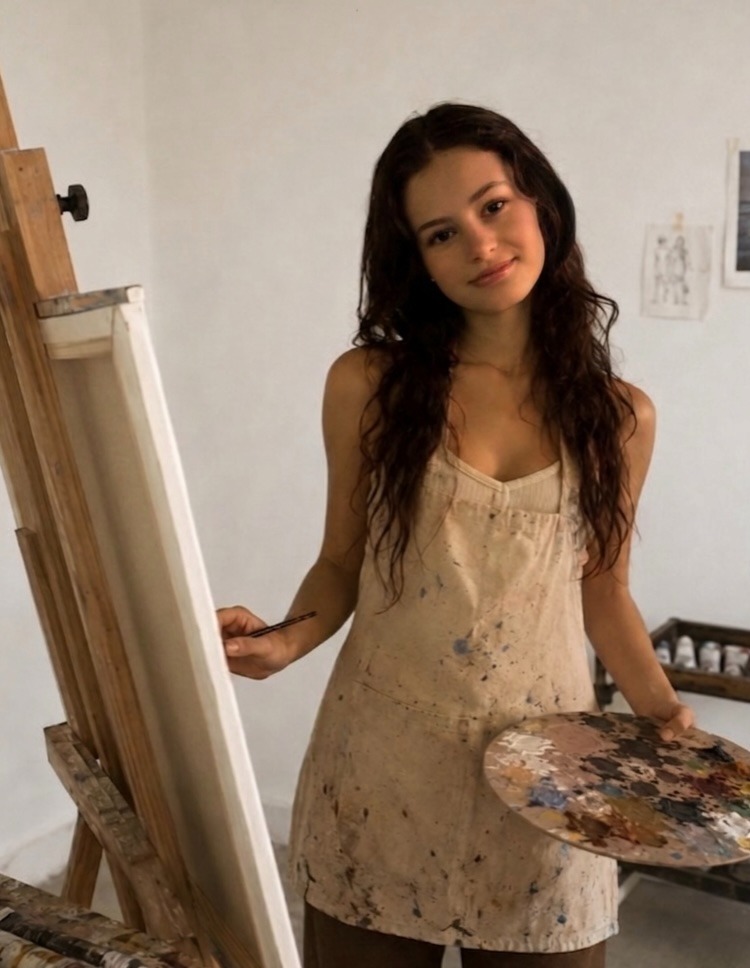


Find Lital on TikTok: @litals.art – Instagram: @litals.art – YouTube: Litalraz3864
Shop prints, book a lesson, or commission a custom piece: lital-shop.fourthwall.com
1. What kind of art do you specialise in?
My primary focus is painting, though I approach it with a fairly exploratory mindset. I don’t confine myself to one subject or technique. I’m especially drawn to portraiture, where I can experiment with colour and expression, but I also enjoy the freedom of looser, more abstract underpainting stages where the rules haven’t been decided yet.
2. Where are you based?
I’m based between London, Ontario and Toronto, which gives me exposure to two very different creative environments. One is quieter and more personal, and the other is fast paced and saturated with culture and opportunity.
3. Do you feel like where you live has had any impact on your art?
Absolutely. I believe everything around you shapes what you create, whether you’re conscious of it or not, from the pace of a city to the quiet of a neighbourhood to the people you pass on the street. Living in London specifically has given me space to slow down and notice detail, which shows up in my work through careful attention to colour and texture rather than rushing toward a finished product.
4. What inspires you?
Almost everything, honestly, and I mean that seriously rather than as a cliché. Inspiration for me rarely comes from grand, deliberate sources. It’s usually something small and unplanned, like the way light falls on someone’s face while I’m walking down the street, or a fleeting expression I catch and can’t stop thinking about. I’ve learned that if I stay observant in ordinary moments, ideas find me rather than the other way around.
5. Do you think individuality is important when creating art?
Yes, deeply so. I think the most important thing an artist can do is figure out what genuinely makes them feel free and excited when they create, and then build their practice around that, rather than chasing trends or what they think “good art” is supposed to look like. When you’re creating from a place of individuality, the work naturally becomes stronger, because you’re not fighting against your own instincts. That freedom is where growth happens.
6. How do you deal with criticism in art?
I try to accept criticism openly, even when it stings, because ultimately the only thing within my control is how I respond to it and use it to improve. I’ve learned to separate the emotional reaction from the substance of the feedback. It’s okay for something to feel uncomfortable in the moment, as long as I don’t let that discomfort stop me from actually absorbing what’s useful in it. I see criticism as one of the fastest ways to grow, even when it’s hard to hear.
7. What is your process of creation? How do your ideas travel to your final piece?
My process varies depending on the piece. Sometimes I throw myself directly into the work with just a loose idea, and I let the piece develop organically as I go. I find that a lot of the best decisions happen in the moment rather than being planned in advance. Other times, especially for more complex pieces, I’ll sit with an idea and generate multiple ways to execute it, sketching out a few different drafts or directions, comparing them, and choosing the one that feels most true to what I’m trying to say before committing fully. So my process is really a mix of instinct and deliberate comparison, depending on what the piece calls for.
8. What is your favourite part of creating?
My favourite stage is the underpainting. It’s the point in the process where I feel the most freedom, because the piece hasn’t been “decided” yet. I can experiment boldly with colour and composition without the pressure of it being final. It’s where a lot of the emotional character of the piece gets established, even if it’s later refined or partially painted over.
9. Do you have any favourite artists?
I don’t have a specific artist I’d point to as a defining influence. I tend to draw inspiration more from moments, people, and everyday life than from studying particular artists’ bodies of work. That said, this is an area I’m looking forward to developing further once I start my Fine Arts studies at Western, where I’ll have more exposure to art history and different practising artists.
10. Do you have any favourite artworks?
Similar to the above, I don’t have one specific artwork I’d call a favourite. My relationship with art has been more about my own process of making than about studying finished pieces, though I expect that to grow and shift as I’m exposed to more formal art education.
11. How do you stay consistent when making art?
I think consistency tends to happen naturally over time, as a reflection of your personal style. You don’t have to force it. That said, I’m cautious about over valuing consistency for its own sake, because I think experimentation is just as important to an artist’s development. I’d rather allow my work to evolve and take risks than lock myself into repeating the same look simply to appear cohesive.
12. Do you ever feel discontent with your artwork, if so how do you deal with it?
Yes, definitely. There’s often a stage in a piece, which I think of as the “ugly phase,” where nothing looks like it’s coming together and it’s tempting to feel discouraged. When that happens, I’ve learned not to force through it. I’ll step away and take a break, or redirect my energy to a different part of the painting, so I can come back to the difficult section with fresh eyes rather than frustration.
13. What are difficulties in selling artwork, how do you deal with them?
The biggest challenge for me has been visibility, simply getting my work seen by the right audience. Because of that, I’ve been intentional about building a presence on social media and growing an audience organically, using it as a way to connect directly with people who respond to my work rather than relying solely on traditional gallery routes.
14. Did you study art in school, if so did you find it beneficial?
Yes, I studied art at H.B. Beal Secondary School, a school known for its strong visual arts program, and I found the experience genuinely valuable. Being surrounded by a wide range of artistic styles, mediums, and peers pushed me to think more critically about my own work and exposed me to approaches I wouldn’t have discovered on my own. This fall, I’ll be continuing that education by studying Fine Arts at Western University, which I’m looking forward to as a next step in developing both my technical skill and my artistic voice.

15. Maurizio Cattelan’s Comedian sold for $6.2 million resulting in media outcry over what constitutes as ‘real art’. Do you think it can be considered as such? Are there parameters for what art is?
I’m hesitant to draw firm parameters around what does or doesn’t qualify as art. The moment you start defining strict boundaries, you inevitably exclude work that challenges or expands those boundaries, which is often exactly what meaningful art is meant to do. If someone creates something they stand behind, and someone else values it enough to pay for it, I don’t think it’s my place to say it isn’t legitimate. Value and meaning in art are subjective, and I think that subjectivity is part of what makes art worth having in the first place.
16. Has the art consumer world become blind to status and over-intellectualising art?
This is a harder question for me to speak to with total confidence, but if I think about it honestly, I do think there’s a real tension in the art world between the emotional, gut level response people have to a piece and the layers of theory, market hype, and reputation that often get attached to it afterward. Sometimes a piece gets valued more for the name attached to it or the story built around it than for what it actually communicates visually. I think that’s worth being critical of, but I also don’t think it invalidates the work itself. It just means the conversation around art can become disconnected from the art.
17. Is ego necessary in art?
I think a certain amount of self belief is necessary. You have to trust your own vision enough to put it into the world and stand behind it, especially in the face of criticism. Whether that counts as “ego” depends on how you define it. I’d distinguish between confidence, which I think is essential, and ego in the sense of needing external validation or status, which I think can actually get in the way of honest creation.
18. Do you think everyone should consume art? If yes, what are the benefits?
Yes, I believe everyone should both consume and create art, regardless of skill level, because the benefits go far beyond the finished product. Art has taught me to approach challenges from multiple angles. When I’m drawing or painting, I have to think about perspective, not just how something looks from one viewpoint, but how it changes depending on where you’re standing. That skill translates directly into real life problem solving. Instead of sticking rigidly to one approach, I’ve learned to step back, reconsider the situation, and try different strategies until I find what actually works.
Art has also taught me adaptability. If I’m sketching in pencil, I can erase and adjust freely. But if I’m working in ink, I have to plan ahead carefully, knowing there’s no undoing my choices. That’s taught me to adjust my approach depending on the tools and constraints I’m working with, a mindset that applies well beyond the studio.
Just as importantly, I think art has strengthened my empathy. Creating something means trying to capture a feeling or tell a story, which requires imagining how someone else might perceive or feel about what they’re looking at. That practice of stepping into another perspective has helped me connect with people, understand different points of view, and handle conflict calmly and thoughtfully. I believe these skills, problem solving, adaptability, and empathy, are exactly the kind of transferable strengths that would make me an asset to a program like the Youth in Policing Initiative, and would help me contribute meaningfully to its community focused work.
19. Does everyone have an innate ability to understand art, whether abstract or classical?
I think everyone has some kind of natural, instinctive response to visual art, even if they can’t articulate why a piece moves them. Whether that response can be deepened is a different question, and I think it can be, through exposure and practice. The more art someone actively engages with, and the more they’re willing to ask themselves what they’re actually responding to, the more refined that appreciation becomes. So I’d say the initial reaction is innate, but the depth of understanding is absolutely something that can be developed and acquired over time.
20. How do you feel about the art that you create?
It’s genuinely mixed, and I think that’s a healthy sign of growth rather than something negative. There are pieces I feel real pride in, and others where I look back and see exactly how I could have executed something better. Because I lean toward perfectionism, I’ll often revisit a finished piece and immediately notice small adjustments I want to make, a line I could sharpen, a shape I could refine. I’ve come to see that instinct as part of caring about the work rather than something to be frustrated by.
21. What is something you wish consumers of art would understand?
I wish people better understood the sheer amount of effort, attention, and decision making that goes into even a single piece: the drafts that get abandoned, the small technical choices most viewers will never consciously notice, and the time spent simply sitting with an idea before a single brushstroke happens. Art can look effortless when it’s finished, but that ease is usually the result of a lot of invisible labour.
22. What is the greatest advice you’ve ever heard in relation to your art?
Don’t be afraid to use colour. It’s advice I return to every time I create, and it shows up clearly across my work, especially in my portraits. I find there’s something genuinely beautiful about how much colour exists in a human face, subtle shifts most people never consciously register, and being willing to bring out bold, unexpected colour rather than playing it safe is what makes my work feel emotionally alive rather than flat.
