
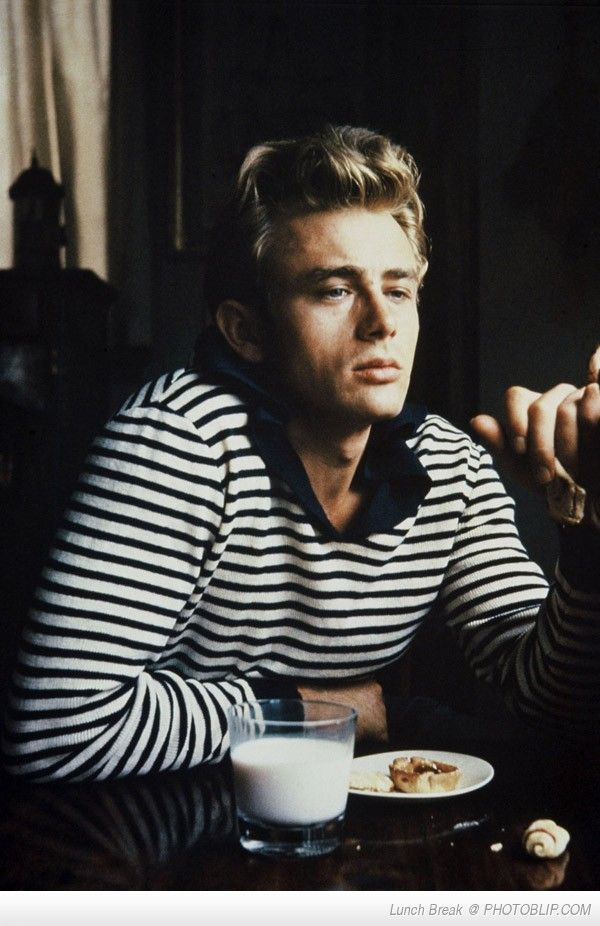



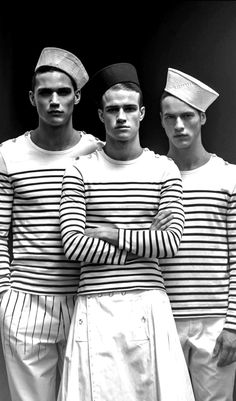
That blue and white horizontal stripe, iconic, grounded and in present-day a testament to style, artistry and composition. The person you see wearing this shirt is fashionable and casual, the stripes do the talking, they are symbolic of the promised brilliance that is expected in the beholder when they decide to own the bold blue and white.
But this shirt has a history, and it stretches far away from the realms of Warhol and our eternal James Dean and instead was birthed in the French Navy in 1858. Before designers and artists claimed it as their uniform, it was a staple for Quartermasters and seamen, chosen for its high visibility as the bold blue stripes made sailors who had fallen off ships much easier to spot, as well as its durable material. Most of the shirts would have been made from knitted wool, which was better adapted for sailing the rough seas.
The name Breton was coined as the shirts became more popular, it refers to Brittany ( a french region) as most sailors were from there. La Marinière literally means “Striped Sweater” with the French Navy regulations describing it as:
Le corps de la chemise devra compter 21 rayures blanches, chacune deux fois plus large que les 20 à 21 rayures bleu indigo.
Translating to – The body shall have 21 white stripes, each twice as wide as the 20 or 21 navy blue stripes.
*The 21 navy blues stripes were said to represent each of Napoleon Bonaparte’s 21 naval victories.
So how did Navy-wear turn into Ready-to-Wear? Famous Fashion Designer Coco Chanel took a keen interest in the shirts, seeing them on her seaside holidays during WWI and would later on launch her own Marinière which quickly turned into a widespread luxury item.
Soon after , most creatives were wearing some form of a Marinière throughout the 20th century – and even now. Notable names include Pablo Picasso, Paul Newman, Audrey Hepburn, and Kurt Cobain. The shirt became a status symbol: luxury mixed with intensity, a bold call to “The Artist” and “The Artfull” -those who live within art, whether as its creators or its admirers.
The Marinière was incorporated into the collections of Jean Paul Gautier, Comme des Garçons, YSL, Ferragamo and so many other luxury brands with Karl Lagerfeld recreating it in his Croisière Lagerfeld collection” [refers to the Chanel Cruise collections, which often had a nautical theme, designed by Karl Lagerfeld between the 1990s and his death in 2019]
So what next for the Breton Shirt? Well Spyder thinks it will stay put, with no intentions of leaving It’s less of a trend and more of a style, and has a symbolism that often adapts and molds into the person wearing it. This allows for an everlasting, everchanging quality in the Marinière and we think it will continue to be influential.
Stay true,
Where All The Love Goes

 Spyder